
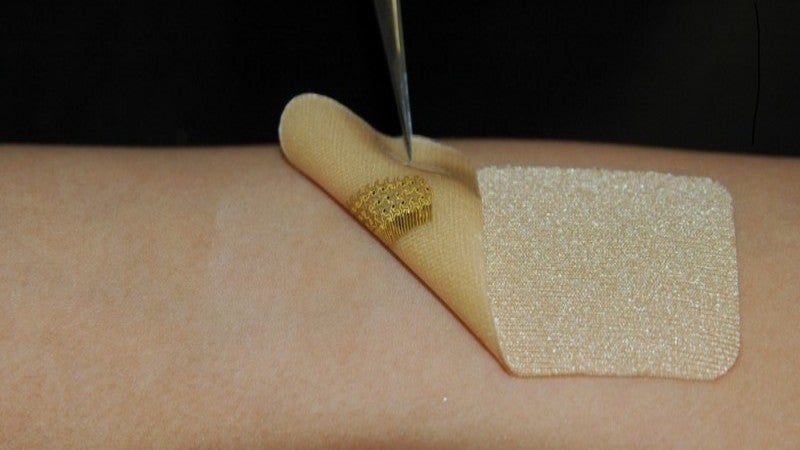
Researchers from universities in Binghamton and New York have developed a wearable biosensor.
This open-mesh electromechanical biosensor is designed to reflect the skin’s microarchitecture. It comprises a biological component and a physiochemical detector that tracks and analyses lactate and oxygen on the skin.
Go deeper with GlobalData


Discover B2B Marketing That Performs
Combine business intelligence and editorial excellence to reach engaged professionals across 36 leading media platforms.
The sensor is also embedded with flexible gold sensor cables that mimic skin’s elasticity.
Binghamton University PhD student Matthew Brown said: “This topic was interesting to us because we were very interested in real-time, on-site evaluation of wound healing progress in the near future.
“Both lactate and oxygen are critical biomarkers to access wound-healing progression.”
The researchers hope that the sensor will integrate additional biomarkers in the future to increase its functionality. The sensors are expected to be incorporated into internal organs to assist in disease research.
Binghamton University biomedical engineering associate professor Ahyeon Koh said: “The bio-mimicry structured sensor platform allows free mass transfer between biological tissue and bio-interfaced electronics.
“Therefore, this intimately bio-integrated sensing system is capable of determining critical biochemical events while being invisible to the biological system or not evoking an inflammatory response.”
The researchers published their findings in the Biosensors and Bioelectronics journal. In the publication, the team noted that the new sensor was able to withstand common harsh, multiaxial stresses when assessed in systematic studies with variations in polymeric membranes.


