

A new study conducted by the Institute of Cancer Research (ICR) and funded by Cancer Research UK has demonstrated that a magnetic resonance imaging (MRI) test could predict and identify patients who would benefit from a certain type of kidney cancer therapy.
Researchers evaluated an MRI technology called susceptibility contrast MRI to measure blood volume in tumours of renal cell carcinoma. This was done before and after treatment with a drug called sunitinib, which is developed to inhibit blood vessel growth.
Go deeper with GlobalData


Discover B2B Marketing That Performs
Combine business intelligence and editorial excellence to reach engaged professionals across 36 leading media platforms.
The results showed that after treatment the volume of blood in tumours decreased by an average of 70%, but their overall size did not change, linking the drug to a reduction in the number of blood vessels in the tumours.
It was also found that tumours with the largest blood volume showed a higher decrease in blood volume.
Based on these findings, the researchers expect that blood volume quantitation can be used as a non-invasive measure of response for drugs that block blood vessel growth in tumours.
The team also expects that tumour blood volume measurement will allow identification of kidney cancer patients who could benefit from sunitinib treatment.
ICR Magnetic Resonance team leader Dr Simon Robinson said: “We found that application of a non-invasive magnetic resonance scanning technique, known as susceptibility contrast MRI, could reliably measure changes in tumour blood volume after treatment with sunitinib.
“We showed that our test for measuring tumour blood volume could in future be used to reliably predict which patients with renal cell carcinoma might benefit from sunitinib, and also provide insight as to why some tumours become resistant to this drug.”
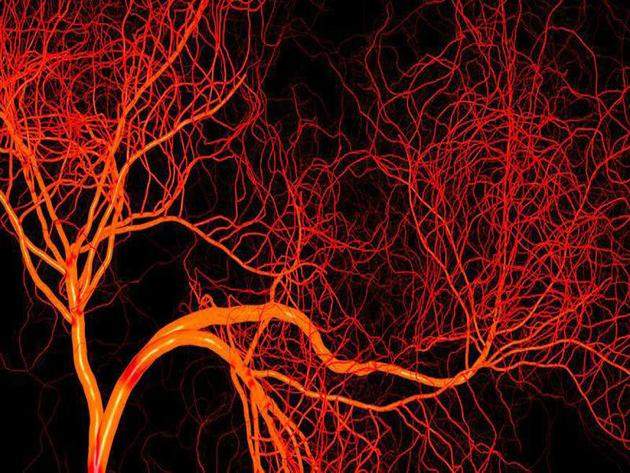
Image: Illustration of blood vessels. Photo: courtesy of The Institute of Cancer Research.


