
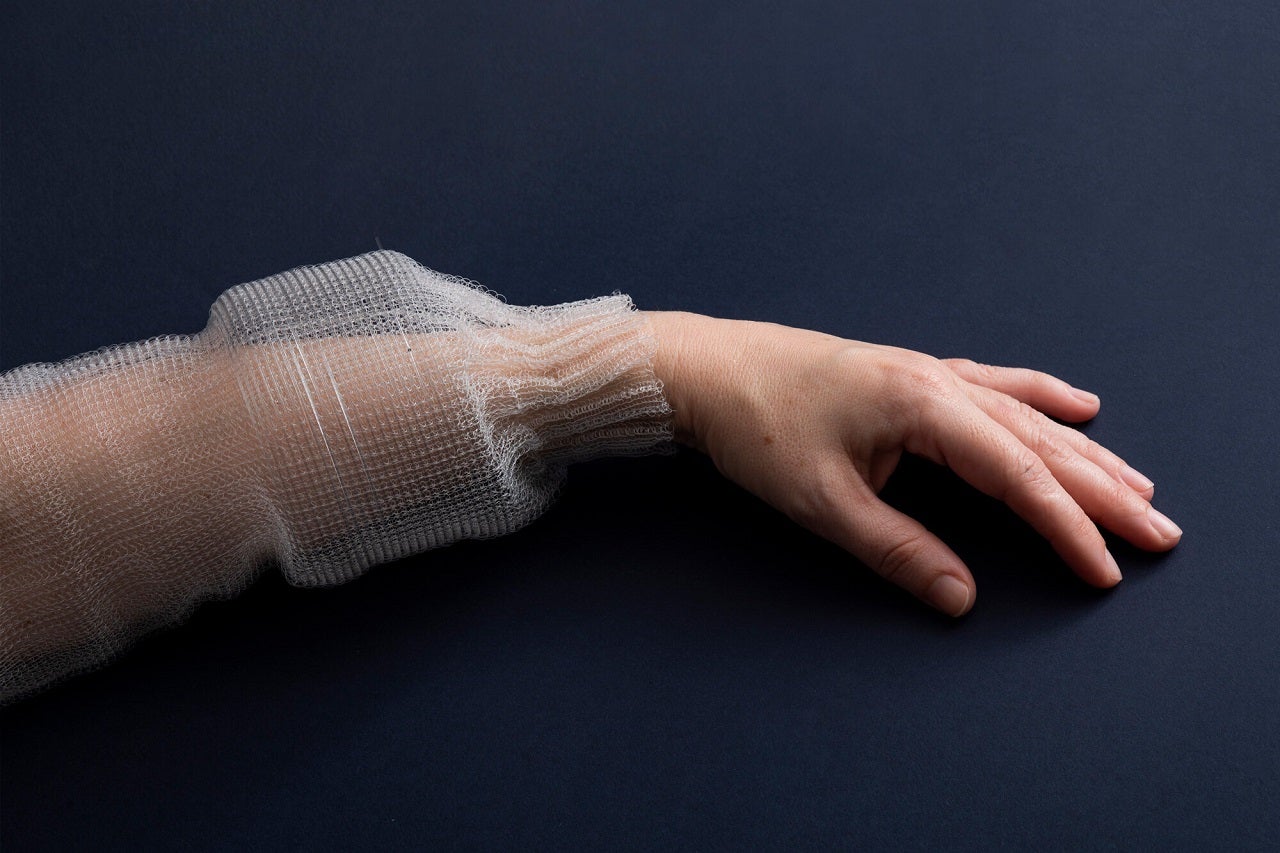
Researchers at Massachusetts Institute of Technology (MIT) have created a digital fibre that can sense, store, analyse and infer activity, and could be sewn into clothing to help monitor physiological functions.
The team behind the development say this is the first example of an electronic fabric that can record digital rather than analogue data, meaning it can be programmed like any other digital device. The technology is described in an article published in Nature Communications.
Go deeper with GlobalData


Discover B2B Marketing That Performs
Combine business intelligence and editorial excellence to reach engaged professionals across 36 leading media platforms.
The fibre was created by placing hundreds of square silicon microscale digital chips into a preform that was then used to create a polymer fibre with a neural network of 1,650 connections.
By precisely controlling the polymer flow, the researchers were able to create a textile with continuous electrical connection between the chips over a length of tens of metres.
The thin, flexible textile can be passed through a needle and sewn into fabrics, and can be washed at least ten times without breaking down.
MIT PhD student Gabriel Loke, one of the lead authors on the paper, said: “When you put it into a shirt, you can’t feel it at all. You wouldn’t know it was there.”
When incorporated into the armpit of a shirt, the fabric was able to collect and store body temperature data over several days and allowed the researchers to monitor the wearer in real time.
The shirt was able to collect 270 minutes of surface body temperature data from the wearer and analyse how it corresponded to different physical activities. Trained on this, the fibre was able to determine what activity the person wearing the shirt was engaged in with 96% accuracy.
Fabrics with digital components can collect a lot of information across the body over time, and these “lush data” are perfect for machine learning algorithms, Loke said.
With this analytic power, the fibres could eventually be used to sense and alert people in real time to health changes like a respiratory decline or an irregular heartbeat.
The fabric is currently controlled by a small external device. The MIT researchers say their next step will be to design a microcontroller that can instead be connected within the fibre itself.


