


October is Breast Cancer Awareness Month. Breast cancer is the most frequently diagnosed cancer in women globally. A key factor in effective treatment is early detection: decades of evidence and cancer outcomes data have shown that finding breast cancer early vastly improves a patient’s prognosis. If cancer is found while still localised to the breast, the five-year relative survival rate exceeds 99%.
Many countries now use mammograms as the primary screening method for breast cancer diagnosis; depending on the country, screening can start between ages 40 and 50 for average-risk individuals. However, in more recent years, the development of in vitro diagnostic (IVD) devices has enabled doctors to not only diagnose breast cancer earlier than mammograms, but also to detect genetic abnormalities that can contribute to breast cancer, such as BRCA [human tumour suppressor genes that, when mutated, significantly increase risk].
Go deeper with GlobalData


Access deeper industry intelligence
Experience unmatched clarity with a single platform that combines unique data, AI, and human expertise.
But many women are still not screened within the recommended windows. This could be due to a multitude of reasons, including limited access to mammogram centres and long waiting times. Introducing early detection breast cancer IVD tests, which only require a simple blood draw, to screening practices can increase the number of women screened per year and thus improve patient survival rates.
GlobalData’s medical devices marketed products database reveals 162 active breast cancer diagnosis and early diagnosis IVD products on the market. The majority of breast cancer IVD products are marketed in the US and Europe, with 86 and 52 products respectively. This demonstrates the large focus of developers on the US compared to other regions. Current and future products in the US will therefore need to show exceptional detection, accuracy and specificity, as well as competitive pricing, to be competitive in this market.
The medical devices pipeline products database also shows that 104 IVD devices for breast cancer diagnosis and early diagnosis of breast cancer are in early to clinical phase development. With most of these tests entering the market by 2027, some manufacturers will aim to establish their tests as the new standard of care alongside mammograms. Two notable cancer diagnosis tests developed by Guardant Health, Shield Multi Cancer (MCD), and the ClearNote Health Avantect MCD test, are currently in a clinical trial called the Vanguard Study: Testing a New Way to Screen for Cancer, intended to show their feasibility as a new method.
These tests are designed to detect biomarkers for different kinds of cancer including breast and bladder, from a patient’s blood sample. The first patient in the Vanguard Study was enrolled in July 2025, so no results are yet available. The trial involves enrolling individuals aged between 45 and 75 who currently do not have cancer and have not received a cancer diagnosis in the past five years. The primary objective is to see whether this type of method would work for cancer screening across the US, whether patients will be able to access the test, whether they receive results in a timely fashion, and whether the appropriate follow-up tests occur when MCD test results are abnormal. The study will demonstrate the demand for blood‑based cancer screening tests when patients are given the option and will highlight the importance of screening for cancers that currently lack established US programs, such as bladder, pancreatic and stomach cancers. It will also show how blood‑based screening can help bridge gaps in care for patients with limited access to existing programmes, including colorectal and breast cancer screening.
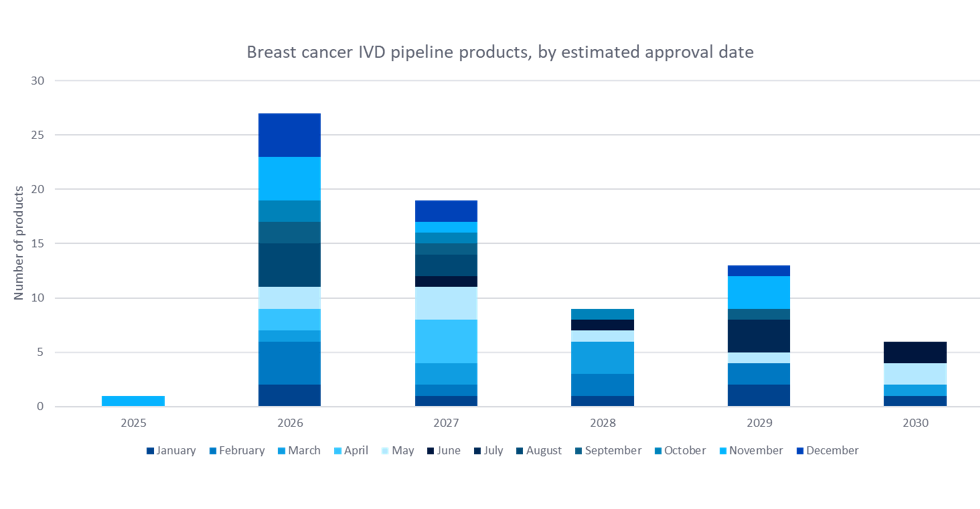
Source: GlobalData.
Breast Cancer Awareness Month serves as a powerful annual reminder of the life-saving power of early diagnosis. With early detection and thus earlier treatment, most breast cancers are survivable. While hundreds of devices will be on the market within a few years, the main barriers to their use will be physicians’ hesitation to introduce new technologies into their practices, and uncertain reimbursement by insurance companies and public health care systems. There is clearly a need for more accessible diagnosis techniques in breast cancer. By covering the gaps in mammogram screening with IVD tests, more patients will have access to care and thus have a higher chance of survival.

