
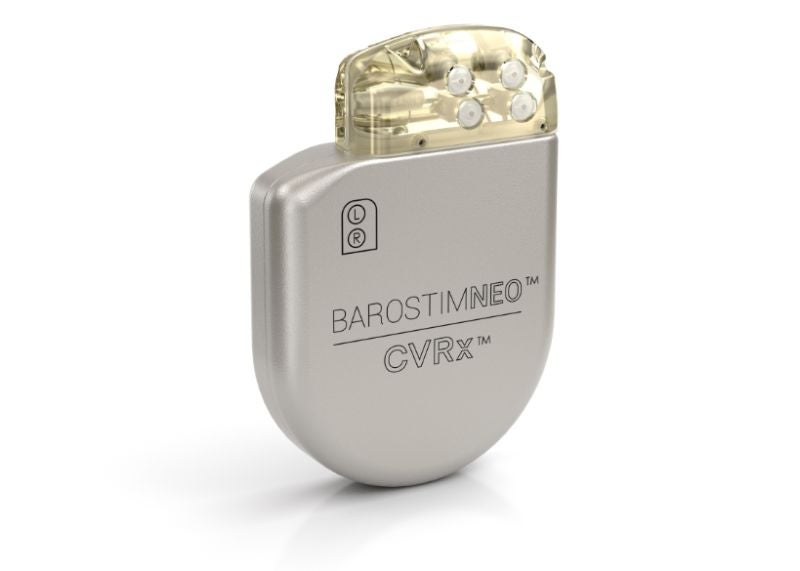
The US Food and Drug Administration (FDA) has approved CVRx’s Barostim Neo System to address symptoms in advanced heart failure patients.
The system is meant for patients who have a regular heart rhythm and are not suitable for other heart failure devices such as cardiac resynchronisation therapy.
Go deeper with GlobalData


Discover B2B Marketing That Performs
Combine business intelligence and editorial excellence to reach engaged professionals across 36 leading media platforms.
Barostim Neo comes with a pulse generator, which can be implanted below the collar bone. The implant is connected to a lead that links to the carotid artery in the neck.
The device is then programmed to send electrical impulses to the baroreceptor cells in the neck which identify blood flow patterns through the carotid arteries and deliver information to the brain.
Subsequently, the brain provides signals to the heart and blood vessels, leading to relaxation of the blood vessels and inhibition of stress-related hormone production to mitigate heart failure symptoms.
The FDA approval is based on positive results from the prospective, multi-centre, two-arm clinical trial that evaluated the Barostim Neo System in a total of 408 participants.
In a separate development, the regulator also approved Zimmer Biomet’s device, The Tether, to treat idiopathic scoliosis in children and adolescents.
Idiopathic scoliosis is characterised by a sideways curvature of the spine.
Designed to correct spine curvature, The Tether comprises anchors and vertebral body screws that are attached to a flexible cord.
During surgery, one side of the spine is compressed by applying tension to the tether, allowing partial correction of the curve.
The FDA said that the tether slows growth on the curved side and stimulates growth on the opposite side of the spine over time. The implant is not removed except in the case of certain problems, such as overcorrections.
The FDA has also authorised expanded indication for Edwards Lifesciences’ Sapien 3 and Sapien 3 Ultra, as well as Medtronic’s CoreValve Evolut R and CoreValve Evolut PRO transcatheter heart valves for severe aortic valve stenosis patients at low risk for death or major open-heart surgery complications.
Previously, these valves had approval for patients who are at intermediate or higher risk.


