
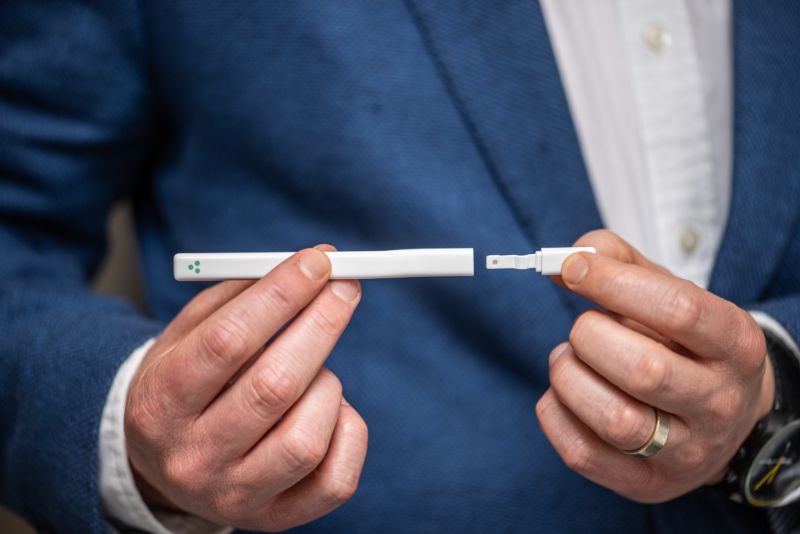
Researchers in Australia have unveiled a new hand-held device that examines saliva for biomarkers of heart disease and warns the user via an app, allowing preventative interventions.
The portable, diagnostic stick has nano-sensors at its tip to measure the biomarkers. It is designed to predict the risk of heart disease, failure or heart attack.
Go deeper with GlobalData


Discover B2B Marketing That Performs
Combine business intelligence and editorial excellence to reach engaged professionals across 36 leading media platforms.
RMIT University researchers have partnered with the Innovative Manufacturing Cooperative Research Centre (IMCRC) to further research and develop the diagnostic for pilot manufacture.
They expect to work with start-up ESN Cleer to make the device commercially available by 2021.
ESN Cleer CEO Leopoldt de Bruin said: “Of the 400 million people who suffer from cardiovascular disease globally, only 16% of cases are due to genetic traits.
“This underlines how much room there is to improve on screening and prevention, which is where this device could have such an impact.”
The new device is backed by a sensing technology developed by the university’s Micro Nano Research Facility team. The technology was found to measure biomarker concentrations far more accurately than levels in body fluids.
RMIT University Functional Materials and Microsystems Research Group research co-director Sharath Sriram said: “Often, blood tests are only conducted after a heart failure episode. Such reactive testing is too late, leaving people with a debilitating illness or leading to deaths.”
“Prevention is always better than cure, which is where this technology comes in, adding accurate prediction to the mix.”
Funding from the IMCRC will provide $3.5m to support the manufacture and large-scale production of the diagnostic swabs, which are expected to cost a competitive price.
The researchers noted that user insights are being considered during the design process. Furthermore, machine learning algorithms will analyse results from the device to improve accuracy over time.
Moreover, the application of the diagnostic device is anticipated to expand for predicting cancer risk.


