
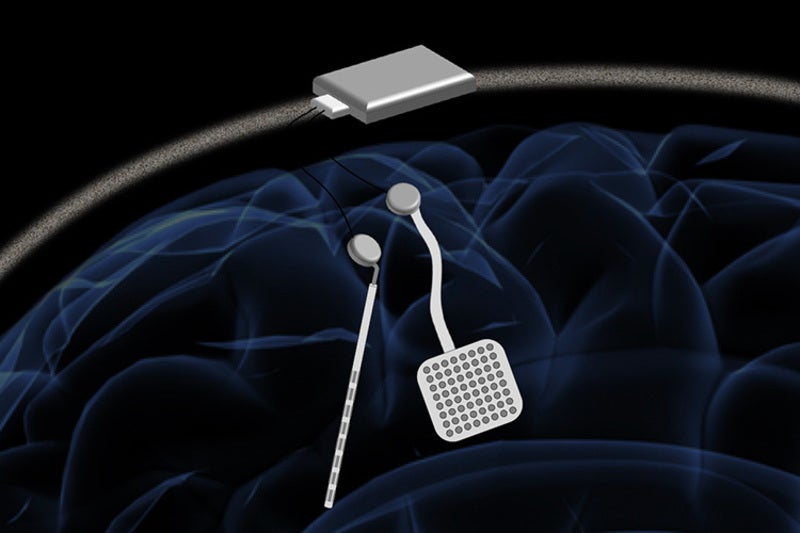
University of California, Berkeley (UC Berkeley) researchers in the US have developed a neurostimulator called WAND to help treat neurological disorders such as epilepsy and Parkinson’s disease.
Designed to act as a ‘pacemaker for the brain’, the device monitors electrical activity and simultaneously delivers electrical stimulation.
Go deeper with GlobalData


Discover B2B Marketing That Performs
Combine business intelligence and editorial excellence to reach engaged professionals across 36 leading media platforms.
WAND has been developed as a wireless and autonomous device in order to enable automatic adjustment of stimulation parameters based on the treatment requirements.
The neurostimulator’s closed-loop feature allows simultaneous recording and stimulation, along with real-time adjustment.
Researchers said that WAND can record electrical activity from 128 points in the brain, which is significantly more than eight channels in other closed-loop devices.
UC Berkeley electrical engineering and computer sciences assistant professor Rikky Muller said: “The process of finding the right therapy for a patient is extremely costly and can take years. Significant reduction in both cost and duration can potentially lead to greatly improved outcomes and accessibility.
“We want to enable the device to figure out what is the best way to stimulate for a given patient to give the best outcomes. And you can only do that by listening and recording the neural signatures.”
The research team of medical device company Cortera Neurotechnologies developed the WAND’s custom integrated circuits, which can record the full signal from subtle brain waves and strong electrical pulses.
The team partnered with UC Berkeley electrical engineering and computer science professor Jan Rabaey to create the wireless and closed-loop computational device that can be used for research and clinical applications.
During a study, researchers evaluated WAND’s ability to recognise and delay specific arm movements in rhesus macaques.
Following a training period, the device was able to detect the neural signatures that occurred as the subjects prepared to perform the motion. WAND then delivered electrical stimulation that delayed the motion.
Muller added: “In the future, we aim to incorporate learning into our closed-loop platform to build intelligent devices that can figure out how to best treat you, and remove the doctor from having to constantly intervene in this process.”


