
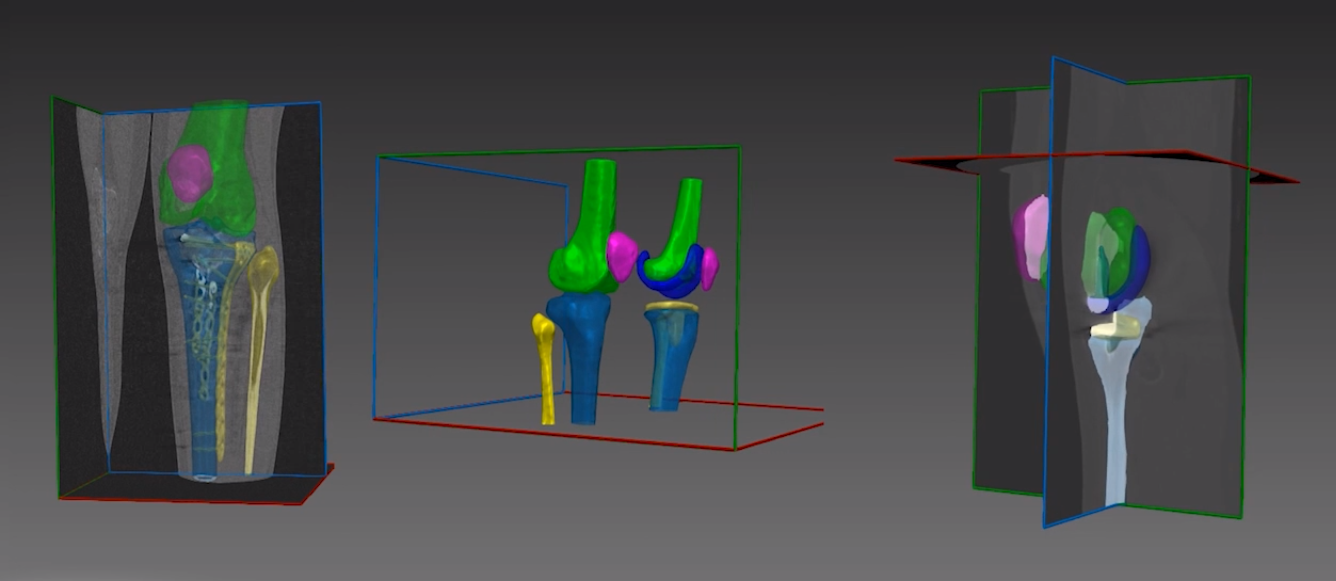
Medical artificial intelligence (AI) company RSIP Vision has launched an advanced joint segmentation tool for detailed, non-invasive planning of orthopaedic procedures.
The AI-based tool is optimised for planning revision arthroplasty and other orthopaedic procedures for patients with pre-existing metal implants, enabling quick and accurate segmentation of different joints from CT scans of hips, knees, shoulders and spines.
Go deeper with GlobalData


Discover B2B Marketing That Performs
Combine business intelligence and editorial excellence to reach engaged professionals across 36 leading media platforms.
RSIP Vision’s deep learning algorithms help clinicians work around any metals in captured in computed tomography (CT) scans, which normally cause severe degradation of the medical imaging.
The tool’s neural network is trained in advance to deal with the presence of metals, accurately discerning the location of metals in the bones and producing uniform, accurate and robust segmentation of all the different elements of both bones and implants, as well as exact delineation of metal fragments from the bones.
RSIP Vision CEO Ron Soferman said: “One of the most common problems in bone segmentation imaging occurs when a CT scan includes the presence of metals in the bones, either due to previous orthopaedic procedures (such as hip replacements) or surgical corrections after a traumatic injury.
“In these cases, the CT images become problematic because of nonstandard absorption values caused by crosstalk between the absorbing pixels and additional artifacts – which result in a challenging image. Moreover, standard segmentation tools can lead to inaccurate outcomes that limit the orthopaedic surgeon’s ability to properly plan for the surgery.”
The technology allows the surgeon to plan more effectively for the surgery, leading to better preparation and setting of expectations with the patient.
Preparing the required implants rather than all the various options also makes financial sense for surgeries, the company said.
The platform can be used in a wide variety of cases, including periprosthetic fractures around implants or fusions, local recurrence of tumours in the presence of implants and repeat femoral neck fracture after fusion.
Soferman said: “This module is a vital and important contribution to the treatment of patients undergoing orthopaedic procedures since many patients undergo additional or follow-up procedures throughout their lifetime.”


