
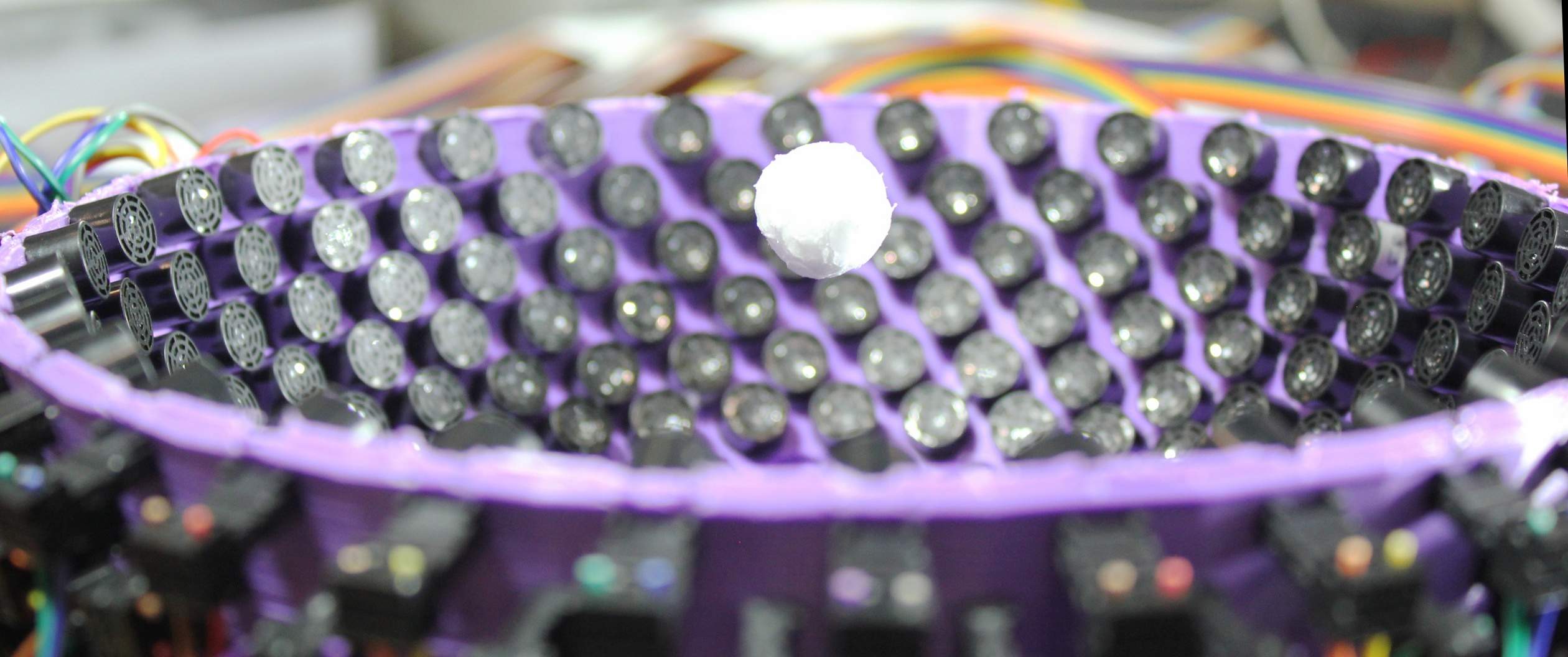
Researchers at the University of Bristol have shown that it is possible to levitate larger objects using an acoustic tractor beam, bringing it a step closer to medical implementation.
The breakthrough shows that it is possible to stably trap objects larger than the wavelength of sound.

Discover B2B Marketing That Performs
Combine business intelligence and editorial excellence to reach engaged professionals across 36 leading media platforms.
Applications could include the manipulation of drug capsules or micro-surgical implements within the body, circumventing the need for a surgical incision. Container-free transportation of delicate larger samples is now also a possibility.
Whilst acoustic tractor beam technology has been around for over thirty years, its application has been limited to very small objects.
“Acoustic researchers had been frustrated by the size limit for years, so it’s satisfying to find a way to overcome it,” said Dr Asier Marzo, lead author on the paper from Bristol’s Department of Mechanical Engineering.
This is because levitation is achieved by firing ultra-high-pitch sound waves at an object. Higher frequencies are made up of smaller sound waves, requiring the object’s size to be smaller than the waves.
Consequently, the elevation of larger objects would require a lower frequency – which would be audible and possibly dangerous to humans.
The new approach, published in Physical Review Letters, uses rapidly fluctuating acoustic vortices – a twister-like structure with loud sound surrounding a silent core – to overcome this.
Working with ultrasonic waves at a pitch of 40kHz, a similar pitch to that which only bats can hear, the researchers successfully held a two-centimetre polystyrene sphere in the tractor beam.
“There is great potential in using virtual vortices to manipulate particles that are inside our body,” said Marzo. “For instance, we can trap and get rid of stones inside a kidney or floaters in the eyes; on the other hand, we can control from the exterior previously inserted drug capsules to guide them towards their target.”
However, there is still a long way to go before clinical use, with the need to prove that the power required to trap particles does not have any harmful effect on tissue. Doctors also need a way of seeing the particle and where it is going.
“What’s really exciting about virtual vortices is that now we can use high-frequency ultrasound to manipulate those particles,” said Marzo.
“This permits us to employ the same machines that are used for ultrasonic imaging to trap particles.”
Some clinical trials have already taken place, with researchers at the University of Washington using ultrasound to push kidney stones. But instead of pushing the particles, Marzo wants to trap and move them.
“I would be incredibly pleased if within five years the ultrasonic imaging machines also had the capability of trapping and moving particles,” he said.
Beyond its medical applications, acoustic tractor bream technology could one day have cross-industry use.
Bruce Drinkwater, Professor of Ultrasonics from the Department of Mechanical Engineering, who supervised the work, said: “Acoustic tractor beams have huge potential in many applications. I’m particularly excited by the idea of contactless production lines where delicate objects are assembled without touching them.”


