
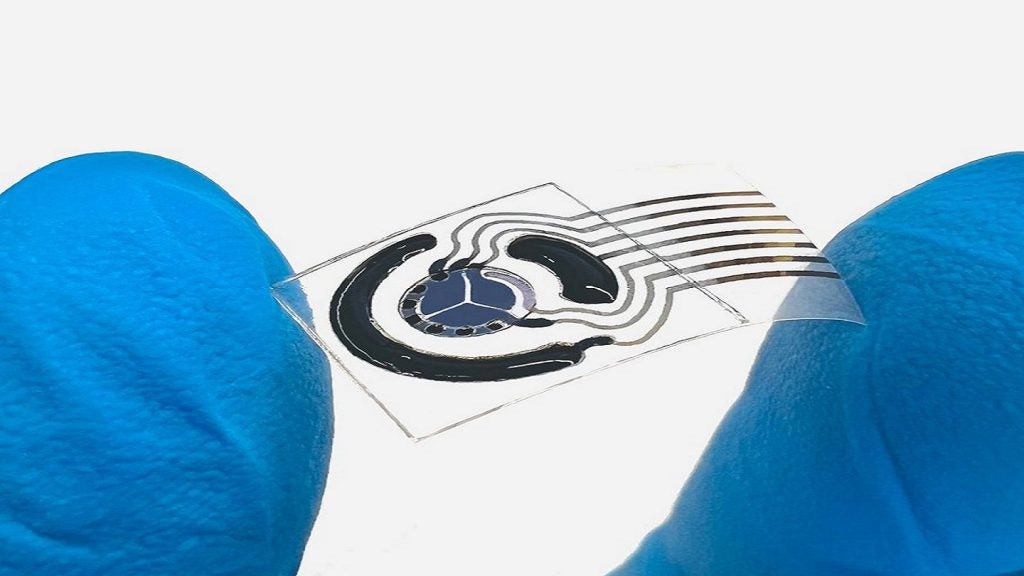
California Institute of Technology (Caltech) engineers in the US have developed an inkjet printing method for producing wearable sweat sensors that can monitor a range of biomarkers in real time.
This allows for the mass production of sensors capable of tracking hormones, metabolites, vitamins and medications offering continuous insights into molecular-level changes.
Nanoparticles, described as core-shell cubic nanoparticles by the Caltech team, are central to the function of these biosensors.
They are created by trapping a target molecule such as vitamin C within a polymer cube during the formation process.
Subsequent removal of the vitamin C leaves behind a polymer shell with holes precisely shaped to detect the target molecules, functioning similarly to artificial antibodies.
The process involves forming cubes in a solution that includes the target molecule, which is then encapsulated as the monomers spontaneously assemble into a polymer.
The sensors' versatility stems from the combination of these molecularly imprinted polymer shells with a nickel hexacyanoferrate (NiHCF) core.
This core can be ‘oxidised’ or decreased when in contact with sweat, generating an electrical signal that varies in strength depending on the presence of the target molecule in the fluid.
This technology was put into practice at the City of Hope in Duarte, California, where wearable biosensors incorporating the nanoparticles were used to monitor metabolites in individuals with long Covid and cancer patients’ chemotherapy drug levels.
Caltech Andrew and Peggy Cherng Department of Medical Engineering's professor Wei Gao said: "Demonstrating the potential of this technology, we were able to remotely monitor the amount of cancer drugs in the body at any given time.
"This is pointing the way to the goal of dose personalisation not only for cancer but for many other conditions as well."
The sensors were specifically designed to identify three distinct antitumour drugs and were printed using multiple nanoparticle ‘inks’ to measure various substances in sweat.
The project received funding from several institutions, including the National Institutes of Health, the National Science Foundation, and the Army Research Office.
Caltech’s Kavli Nanoscience Institute offered the required support and infrastructure.