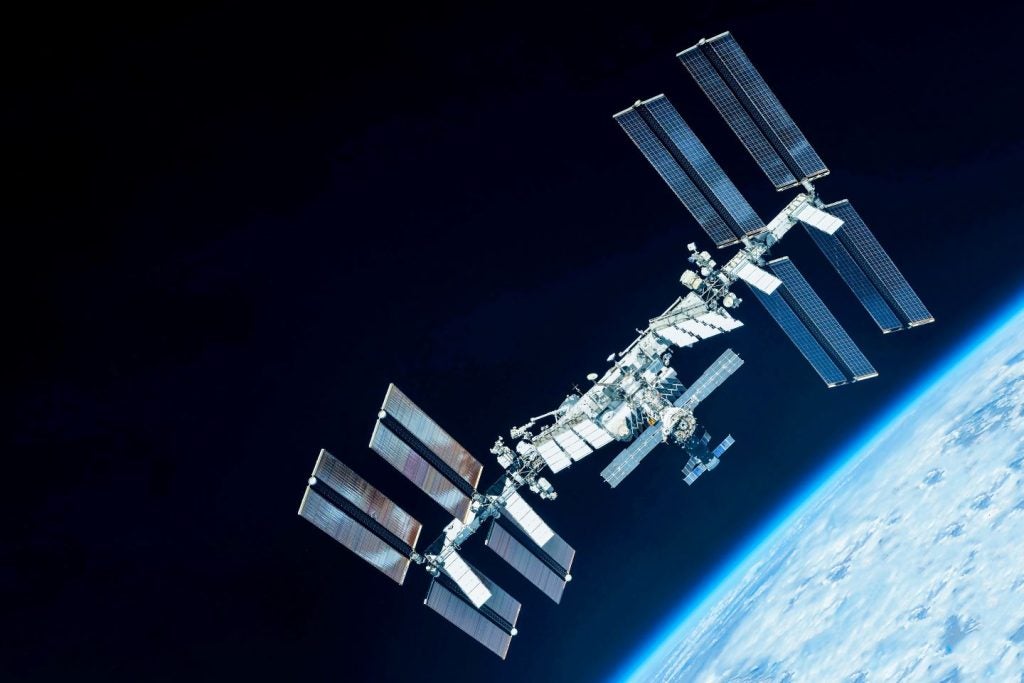
GE HealthCare’s Vivid iq ultrasound system has been sent to the International Space Station (ISS).
Vivid iq is comprised of imaging capabilities and quantification tools for examining body systems relating to areas including cardiovascular, abdominal and musculoskeletal health. With laptop-sized form factors, the system serves as an update to GE HealthCare’s Vivid q, which was launched to the ISS in 2011.
Stowed aboard SpaceX’s resupply vessel, the US imaging giant’s system arrived at the ISS on 18 September and will play a key role in general crew health assessments. The system will also be used in space research investigations centred on bodily analysis such as venous blood flow and heart function throughout long-duration spaceflight.
Vivid iq’s planned in-flight studies will be run by NASA's Human Research Program. The ultrasound research undertaken aboard the ISS will focus on how astronauts’ health can be improved while in space, GE HealthCare said, with evaluative studies aimed at developing health measures and diagnostic protocols for spaceflight, while also looking at how scanning capabilities and protocols can be improved to help patients on Earth.
Philip Rackliffe, president and CEO of advanced visualisation solutions at GE HealthCare, commented: "The journey of Vivid iq to the International Space Station marks more than just a technological milestone.
“It is a bold affirmation of our vision to empower confident clinical decisions in the most extreme environments, with technology crafted for precision, built for portability and driven by purpose.”
GE HealthCare’s Vivid iq is not the first medical device to make it to the ISS. As part of an initiative by NASA that supports technologies aiming to advance manufacturing in space, Auxilium Biotechnologies had a research proposal accepted by the space agency in April 2022, clearing the US-based company to initiate proof-of-concept demonstrations of its 3D bioprinter on the ISS.
The demonstration of Auxilium’s technology took place in February 2025, wherein the company’s Auxilium Microfabrication Platform (AMP-1) bioprinter simultaneously built eight implantable medical devices for peripheral nerve repair aboard the ISS in two hours.
While still in its early days, NASA is optimistic that medical device manufacturing in space is a promising growth prospect. In space, the absence of gravity opens opportunities for undertaking manufacturing tasks that would be infinitely more complex, and potentially impossible, to achieve on Earth.