

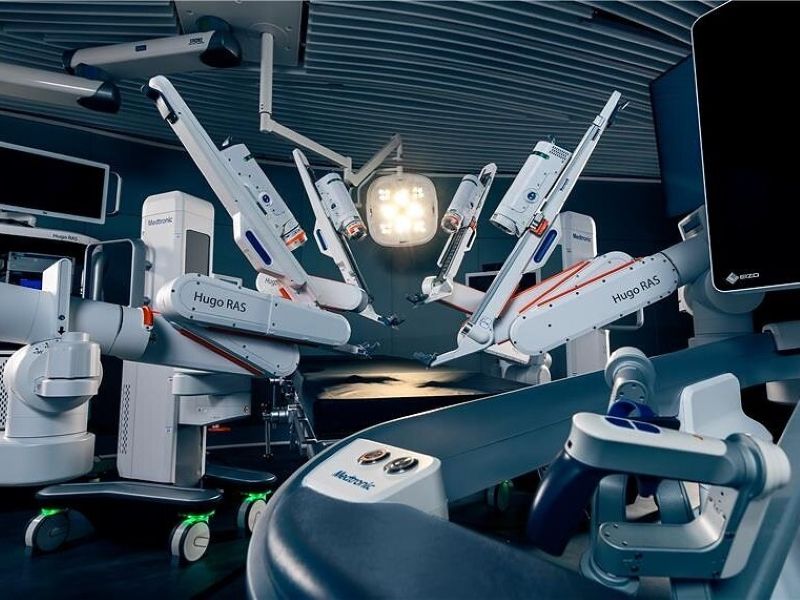
The Hugo™ robotic-assisted surgery (RAS) system is a modular, multi-quadrant platform designed to support surgeons in controlling instruments and accessories during a range of teleoperative soft-tissue procedures.
Developed by Medtronic, the software-controlled, electromechanical system comprises capital equipment, compatible instruments, and accessories.
Recommended Buyers Guides

The system is commercially available in more than 35 countries across five continents, including the US, Europe, Canada, and Australia.
In September 2026, the US Food and Drug Administration (FDA) cleared the LigaSure™ RAS Maryland jaw device for the Hugo RAS system. The instrument was previously approved in Europe in 2025.
Regulatory approvals
The Hugo RAS system received CE marking in the European Union (EU) in October 2021 for urological and gynaecological procedures and subsequently received CE mark for general surgeries in October 2022.
The system is also approved by Health Canada for general laparoscopic surgeries and Japan’s Ministry of Health, Labor, and Welfare (MHLW) for urological and gynaecological procedures.
The FDA approved the Hugo RAS system for use in urological surgical procedures in December 2025.
In June 2026, Medtronic submitted 510(k) notifications for the system’s use in general surgery and gynaecological procedures in the US.
Design and instruments of Hugo RAS system
The Hugo RAS system incorporates a modular architecture that integrates wristed instrumentation with 3D visualisation.
The platform consists of several core components, including arm cart assemblies, open surgeon console, system tower, and surgical instrumentation.
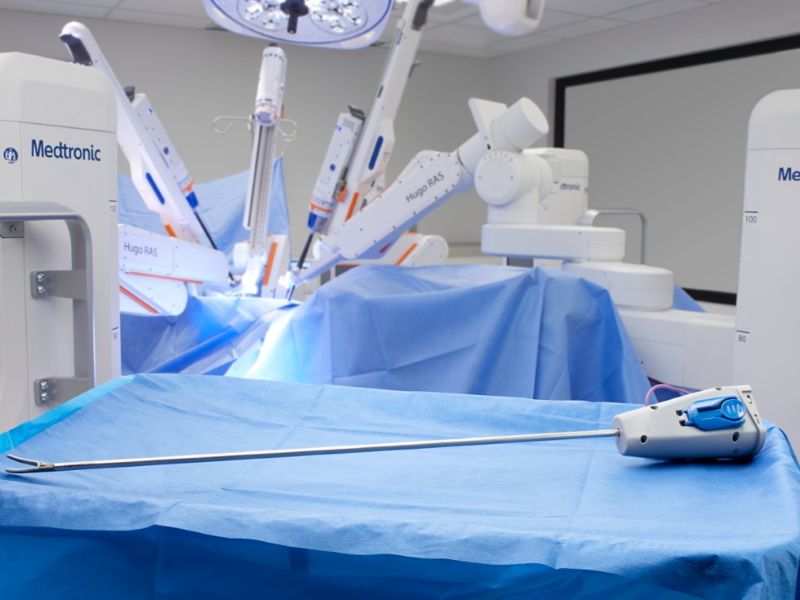
The system supports nine dedicated wristed instruments, including monopolar and bipolar forceps, needle drivers, and graspers. It is compatible with both single-use and reusable trocars.
The RAS system uses Touch Surgery™ Enterprise, a cloud-based video capture and surgical data management platform, Hugo ASCEND training programme, and Medtronic Hypercare technical and operational support services.
Details of Hugo RAS arm carts
The Hugo RAS system can be configured with up to four independent robotic arm carts. Its modular architecture allows the arms to be repositioned through a 510° range, shared between procedures, and deployed in different care settings. The configuration can also be adapted to support access to the relevant anatomy for each procedure.
The robotic arms provide multiple degrees of freedom and incorporate a tilt joint for access to complex anatomical targets. The adjustable height of the arm cart assembly supports access to different anatomical locations while its range of motion enables multi-quadrant access.
Hugo surgeon console details
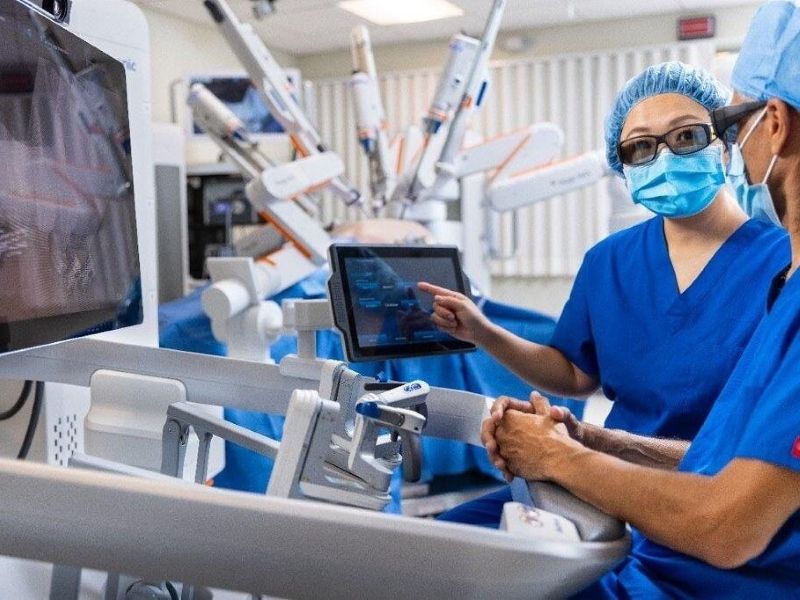
The Hugo RAS system features an open surgeon console that maintains a direct line of sight to the bedside team. Surgeons can operate from an upright position while viewing a 3D monitor and adjusting the console to suit their individual preferences.
The console’s hand controllers are designed for instrument manipulation at different scales. The configuration is intended to reduce physical strain and facilitate training, communication with the bedside team, and integration with the wider surgical team.
During training and proctoring sessions, the surgeon, trainee, and proctor can view the 3D display simultaneously, allowing hand movements to be observed in real time.
Hugo RAS tower details
The Hugo RAS tower functions as the central processing unit of the robotic system and provides an interface between the surgeon console and the arm carts. It integrates KARL STORZ™ imaging technology with the Valleylab™ FT10 energy platform, which is compatible with the system’s energy-based devices.
The tower features a 32in widescreen interactive display, which supports full-HD, 3D imaging and offers four fluorescence imaging modes through the KARL STORZ IMAGE1 S™ RUBINA™ system. Its video outputs can connect with existing operating room displays, while its 3D HD endoscope can be mounted on any robotic arm.
Integrated ecosystem on Hugo RAS
The Hugo RAS system is integrated with the Touch Surgery™ ecosystem, an AI-enabled platform that processes surgical data, video recordings, and procedural analytics.
The software enables surgical teams to review procedure recordings and performance metrics, as well as share case data with colleagues. The Touch Surgery Live Stream functionality also supports real-time video transmission, allowing for intraoperative peer coaching and surgical broadcasting.
Details of LigaSure instrument
The LigaSure™ RAS Maryland jaw device is the first-ever robotic-driven instrument and incorporates vessel-sealing technology. It is designed to seal and transect vessels, tissue bundles, and lymphatics measuring up to and including 7mm in diameter.
The instrument achieves vessel closure in approximately two seconds while minimising thermal spread to adjacent tissue.
Clinical trial on Hugo robotic-assisted surgery system
The FDA’s approval of the Hugo RAS system for urological procedures was based in part on findings from Expand URO (NCT05696444), a prospective, multi-centre, non-randomised, single-arm study. The study assessed the safety and effectiveness of the system in robotic-assisted urological surgery.
The study enrolled 137 patients at six investigational sites in the US. It included 29 cystectomy procedures, 53 nephrectomy procedures, and 55 prostatectomy procedures. Researchers collected data for all participants up to 30 days after surgery.
The primary safety endpoint measured the rate of Grade 3 or higher complications. Reported rates were 3.7% for prostatectomy, 1.9% for nephrectomy, and 17.9% for cystectomy. These rates were below the respective performance goals of 20%, 20%, and 45%, which were established through a systematic review of published literature for each cohort.
The primary effectiveness endpoint was surgical success. The study reported a surgical success rate of 98.5%, compared with a performance goal of 85% derived from a systematic review of published literature.
