
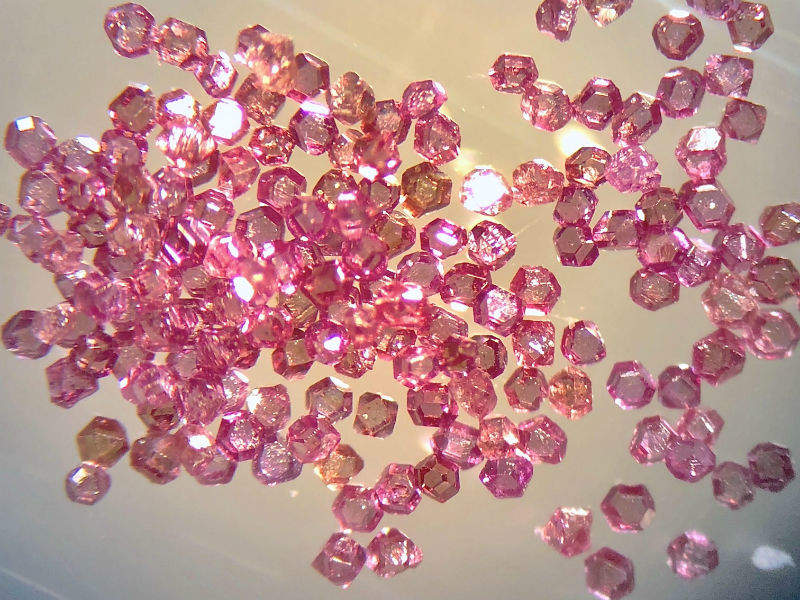
An international study led by scientists at the Department of Energy’s Lawrence Berkeley National Laboratory and UC Berkeley has shown how a new technique involving diamonds could lead to low-cost medical imaging and drug discovery devices.
The scientists have described the technique in the Science Advances journal.
Go deeper with GlobalData


Discover B2B Marketing That Performs
Combine business intelligence and editorial excellence to reach engaged professionals across 36 leading media platforms.
The team discovered how to exploit defects in nanoscale and microscale diamonds. They used this process to enhance the sensitivity of magnetic resonance imaging (MRI) and nuclear magnetic resonance (NMR) scanners, while eliminating the need for the costly and large superconducting magnets in the machines. There is therefore the potential for this technique to shrink these large scanning devices from room-sized to benchtop-sized.
Some of the most advanced MRI and NMR machines can be too costly for some hospitals and research institutions.
UC Berkeley postdoctoral researcher and lead author of the study Ashok Ajoy said: “This has been a longstanding unsolved problem in our field, and we were able to find a way to overcome it and to show that the solution is very simple. No one has ever done this before. The mechanism that we discovered is completely new.”
The researchers are aiming to transfer their ‘special tuning’, known as spin polarisation, to fluids such as water so they can inject the fluid into a patient for faster MRI scans. They note that the high surface area of the tiny particles is essential to this process.
The scientists believe that enhancing spin polarisation in the electrons of atoms in diamonds could provide a sharper contrast for imaging than conventional superconducting magnets.
Ajoy said: “This important discovery in the hyperpolarisation of nano and microscale diamonds has enormous scientific and commercial implications. This could help expand the market for MRI and NMR.”
The scientists also found that applying green laser light to a collection of microscale diamonds, subjecting it to a weak magnetic field, and sweeping across the sample with a microwave source, could enhance the controllable spin polarisation property in the diamonds by hundreds of times compared with conventional MRI and NMR systems.
The team has already developed a miniaturised system that can use off-the-shelf components to produce the laser light, microwave energy, and the magnetic fields required to produce spin polarisation in diamond samples. They have applied for patents on the technique and the hyperpolarisation system. Prototypes of the system cost several thousand dollars.
The project initially used diamonds around 100 microns in size. After testing, the researchers found that diamonds measuring about one to five microns performed almost twice as well.
The tiny diamonds can be manufactured through economical processes such as converting graphite into diamond.
The researchers are now exploring ways to continuously polarise the samples, and working out how to transfer this polarisation to liquids.


