
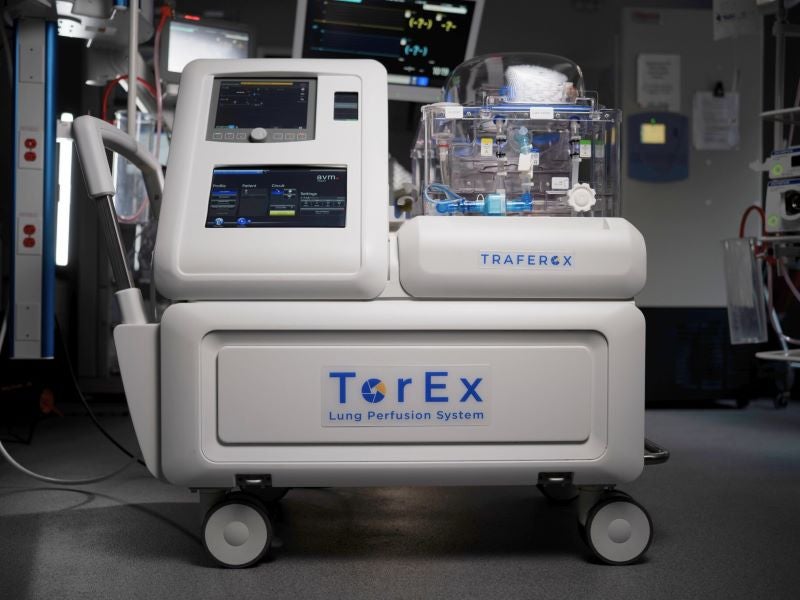
The TorEx Lung Perfusion (TLP) System is an ex vivo lung perfusion (EVLP) platform used to evaluate donor lungs outside the body before transplantation, to support more informed clinical decision-making.
Developed by Traferox Technologies, the TLP System is designed to be used in conjunction with TorEx Lung Perfusate as an integrated clinical EVLP solution.
Recommended Buyers Guides

The TorEx System helps evaluate the condition and quality of donated lungs; however, the final decision on whether the lungs are suitable for transplantation remains the responsibility of the transplanting surgeon.
Regulatory approvals
Traferox began development of the TorEx System in 2021. The company obtained a Health Canada Class II Medical Device Licence (No. 108277) for the system in September 2022. Commercial use of the system in Canada began in December 2022.
Since then, more than 400 perfusion procedures have been carried out at two Canadian hospitals, contributing to the availability of more than 250 donor lungs for transplantation that might otherwise have been discarded.
The system received approval from the Israeli Ministry of Health in February 2025.
Traferox was granted premarket approval for the TorEx system by the US Food and Drug Administration (FDA) in June 2026.
TLP System design and features
The TLP System comprises a mobile cart with embedded software and single-use sterile components such as an organ chamber and cannula set. It is used together with the TorEx Lung Perfusate solution to conduct EVLP for periods of up to six hours.
The system keeps the lungs in a sterile chamber, providing ventilation and perfusion at normal body temperature.
TorEx Lung Perfusate is a physiological saline-based solution containing human serum albumin and Dextran 40. Dextran 40 helps limit tissue swelling and supports the microcirculation by reducing the risk of reperfusion damage after ischaemia, while human serum albumin maintains colloid osmotic pressure, which in turn helps to avert oedema.
The electrolyte balance, pH and human serum albumin content are formulated to mimic key characteristics of human blood plasma.
The TLP System is designed to streamline application of the Toronto Technique by incorporating all essential components for the procedure and consolidating system controls in a single central interface.
Toronto EVLP technique details
The Toronto EVLP technique is a standardised EVLP method originally developed and clinically validated by the Toronto Lung Transplant Program. The approach has enabled more lung transplants than any other programme worldwide.
This approach uses normothermic perfusion combined with protective mechanical ventilation to keep donor lungs in a physiologically active state outside the body, allowing functional assessment before transplantation.
EVLP enables donor lungs to operate under near-physiological conditions outside the body so that clinicians can evaluate their suitability for transplantation.
TLP cart hardware details
The TLP cart incorporates three touchscreens, the perfusion console, the BELLAVISTA® 1000 ventilator interface and the cart control screen.
The perfusion console controls the circulation of the perfusate through the lungs during EVLP.
Ventilation within the TorEx system is managed via the BELLAVISTA 1000 ventilator, which is integrated into the front of the cart. It enables users to set and monitor ventilation parameters and variables in line with the Toronto EVLP technique.
The TLP cart can accommodate two gas cylinders, one with medical‑grade oxygen and one with medical‑grade EVLP gas, used according to the Toronto EVLP protocol.
Mobility features include a handlebar and castors equipped with a locking mechanism.
Clinical studies on TLP System
The FDA’s premarket approval for the TLP System was supported by the TorEx Study.
The retrospective, non-randomised, single-centre clinical trial compared outcomes in patients who received donor lungs treated with EVLP using the TorEx system with outcomes in patients who received donor lungs transplanted directly without EVLP during the same period.
The EVLP cohort comprised recipients of lungs perfused on the TorEx System who underwent lung transplantation between 6 December 2022 and 7 November 2025. The control cohort comprised recipients of lungs transplanted according to standard of care (SOC) without EVLP over the same time frame.
All transplants were carried out at Toronto General Hospital and the dataset covered 600 patients.
The primary endpoint was the incidence of International Society for Heart and Lung Transplantation primary graft dysfunction grade 3 (PGD3) at 72 hours after transplantation.
PGD3 was defined as the presence of pulmonary oedema on post-operative chest radiography together with a ratio of arterial oxygen partial pressure to inspired oxygen fraction (PaO₂/FiO₂) of less than 200mm of mercury.
Secondary endpoints included duration of post-transplant mechanical ventilation, length of post-transplant hospital stay, length of post-transplant intensive care unit (ICU) stay, survival analysis and chronic lung allograft dysfunction-free survival.
The incidence of PGD3 at 72 hours post-transplantation was 16/204 (7.8%) in the EVLP group and 38/349 (10.9%) in the SOC group. Overall, outcomes were broadly similar between the two arms, with EVLP showing a potential advantage.
The 12‑month survival rate was 132/161 (82%) in the TorEx EVLP group and 231/283 (81.6%) in the non‑EVLP SOC group, indicating similar longer‑term clinical performance while acknowledging the potential advantage offered by EVLP.
Indicators of functional recovery were broadly aligned between groups: the mean duration of mechanical ventilation was 9.5 days versus 5.8 days, the mean ICU stay was 12 days versus 10.2 days and the mean total hospital stay was 35 days versus 35.1 days for the EVLP and control groups, respectively. During the study period, the donor lung utilisation rate following assessment on the TLP System was 66%, with 221 of 336 evaluated lungs proceeding to transplantation.
