
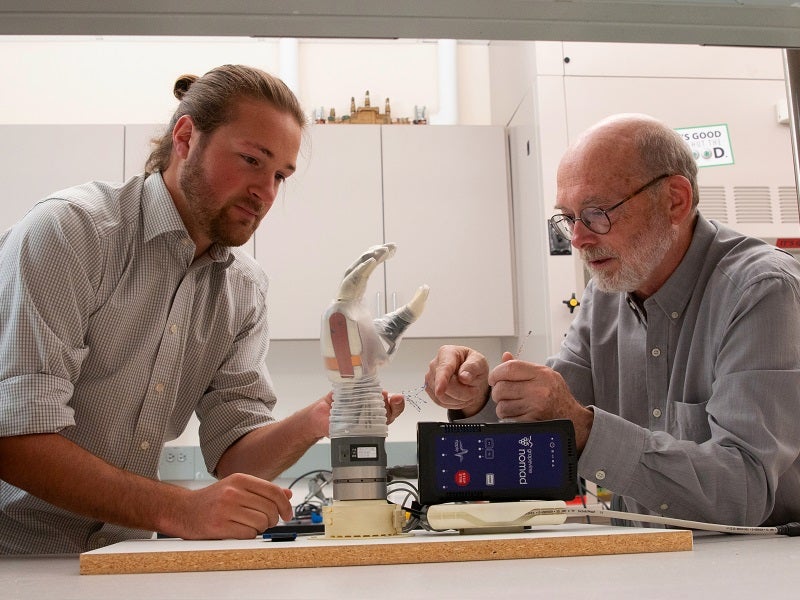
Researchers at the University of Utah have restored the sense of touch for a man who lost his arm 17 years ago through the use of a brain controlled robot prosthetic.
The LUKE arm, which has been in development for 15 years, taps into the wearer’s nerves to send signals back to the brain, mimicking a sense of human touch.
Go deeper with GlobalData


Discover B2B Marketing That Performs
Combine business intelligence and editorial excellence to reach engaged professionals across 36 leading media platforms.
Test subject Keven Walgamott, whose arm was amputated below the elbow after an accident 17 years ago, can now use the prosthesis to ‘feel’ 119 different touch sensations. For example, he can distinguish between large, small, soft and hard objects and is able to handle delicate items like eggs and grapes.
Walgamott said: “It almost put me to tears. It was really amazing. I never thought I would be able to feel in that hand again.”
The arm works through an array of microelectrodes called the Utah Slanted Electrode Array (USER) implanted in the wearer’s forearm and connected to a computer, allowing communication between the prosthetic arm and the brain. Through the prosthesis’ 19 touch sensors, the artificial hand then sends computer generated touch signals back to the brain. USER also interprets signals from the remaining nerves in the arm to move in the prosthesis in six different directions as the wearer desires. It is also able to detect temperature and pain.
The team recorded impulses from a primate’s arm to create an approximate model of how humans receive different touch signal patterns, the model for which was then incorporated into the design of the LUKE arm system.
University of Utah biomedical engineering associate professor Gregory Clark said: “Just providing sensation is a big deal, but the way you send that information is also critically important, and if you make it more biologically realistic, the brain will understand it better and the performance of this sensation will also be better.”
Research has current focused only on below-the-elbow amputees, but Clark believes it can be generalised to those who have lost their arm above the elbow. The Utah team is currently focused on developing a version of the LUKE arm which is portable and does not need to be connected to an external computer to work, which they hope to see test subjects take home in 2020 or 2021.


