
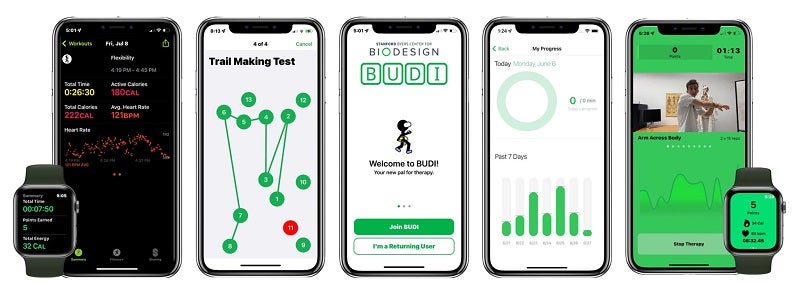
A medical student at Stanford University has developed a new wearable device that helps children with cerebral palsy perform therapy exercises at home or elsewhere.
The new Biofeedback Upper-limb Device for Impairment (BUDI) was originally a bulky bracelet with sensors that tracked motion and provided feedback regarding how users might want to adjust their movement.
Go deeper with GlobalData


Discover B2B Marketing That Performs
Combine business intelligence and editorial excellence to reach engaged professionals across 36 leading media platforms.
The device is designed to address a need in the cerebral palsy community, which covers a group of disorders that affect movement, balance and posture.
Children with cerebral palsy need daily sessions with a physical therapist to improve motor skills and build strength.
Stanford medical student Blynn Shideler and his team developed two prototypes.
BUDI has now been developed into an application that helps users follow therapeutic exercises on an iPhone. Motion data from a user’s Apple Watch is sent to the iPhone in real-time to provide biofeedback and create an interactive mobility training programme.
User data will be stored in HIPAA-compliant security on Google Cloud and completely integrated into Apple Fitness to track the therapy and progress in Apple Health.
Stanford University School of Medicine neurology and neurological sciences clinical assistant professor Jennifer O’Malley said: “Regular participation in high-quality therapy services is essential to maximising function for children with cerebral palsy.
“Equitable access (geographically, financially, socially) to such services is a major barrier for many children.
“Blynn’s device employs easy-to-use technology to bring a novel approach to therapy that also begins to address the problem of accessibility and equity for children in need.”
The new platform also enhances communications between therapists and their patients, allowing children to gain autonomy in their own therapy.
O’Malley added: “A single device utilising modern technology while also combating gaps in equity and accessibility and promoting user autonomy is an exciting and very welcome innovation!”


