
Testing of Spinal Implants

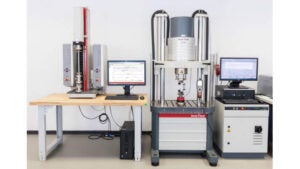
Pulsating compressive strength tests (R=0.1) are performed on six specimens with a test frequency of up to 5Hz. Result: Generation of a Wöhler curve with a number of cycles to crack up to 5 million.
This corresponds to approximately two years in-vivo, with approximately 7,000 cycles per day. The first runout is confirmed.
In addition to purely axial tensile, compression and flexure tests, a pure or combined torsion load can be applied to spinal systems in compliance with standards including ASTM F1717-9, ASTM F2706-8 or ISO 12189-08.
These tests can be performed under physiological (in-vivo) conditions (for example, tempered saline solution) using a Zwick thermoregulation bath:
- ASTM F1717-9 Standard Test Methods for Spinal Implant Constructs in a Vertebrectomy Model
- ASTM F2706-8 Standard Test Methods for Occipital-Cervical and Occipital-Cervical-Thoracic Spinal Implant Constructs in a Vertebrectomy Model
- ISO 12189-8 Implants for surgery – Mechanical testing of implantable spinal devices, Fatigue test method for spinal implant assemblies using an anterior support
For practical statistical evaluations of fatigue tests in the finite life range (high-cycle fatigue) and in the transitional range to fatigue strength (long-life fatigue), Zwick offers the technical-scientific programme Statistical Analysis of Fatigue Data (SAFD).