
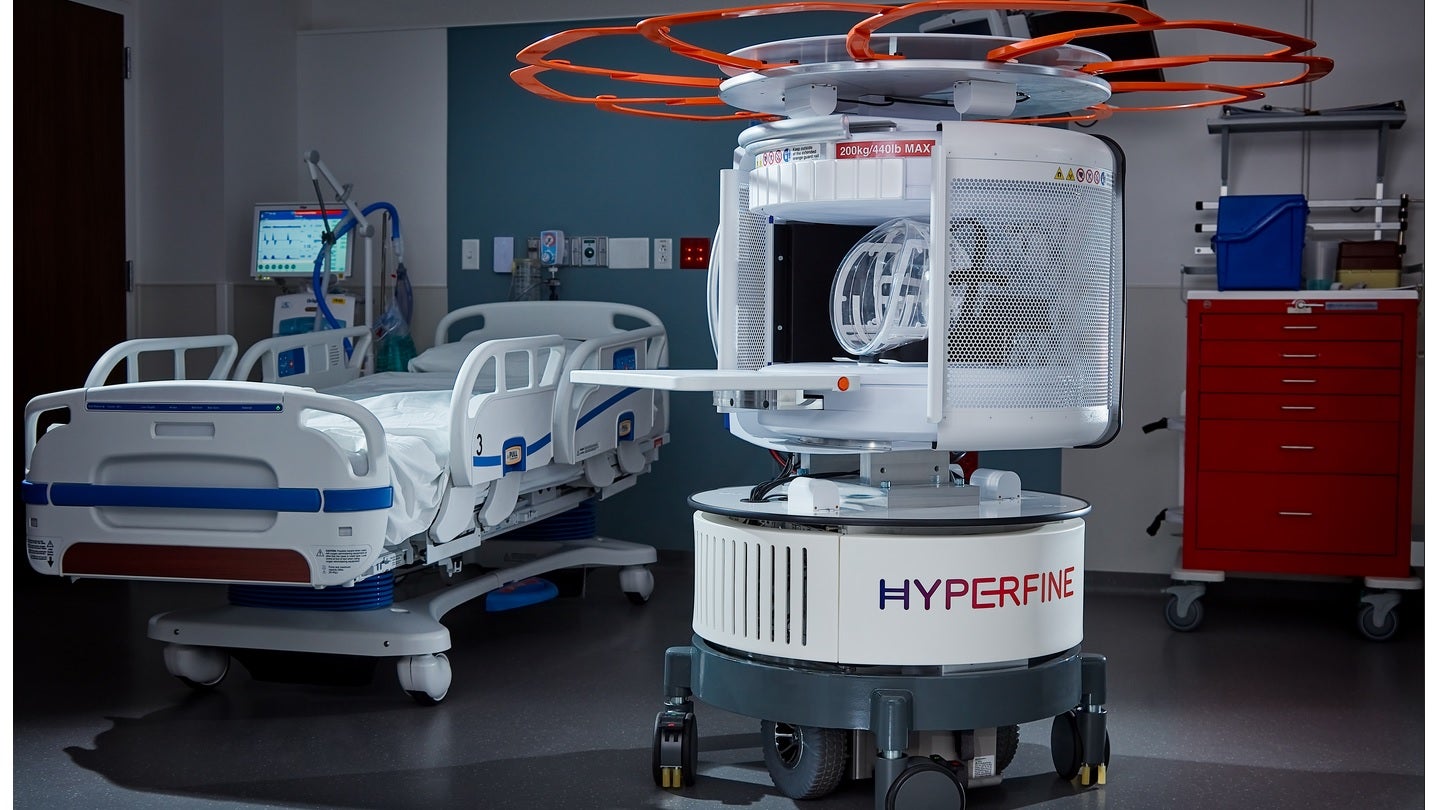
Hyperfine is collaborating with NVIDIA to advance the AI capabilities of the Swoop Portable magnetic resonance imaging (MRI) system.
The companies said the collaboration will focus on advancing AI-powered image reconstruction and embedding real-time clinical decision support into Swoop’s workflows. Nvidia’s suite of training and inference tools such as NVIDIA DALI and MONAI will be used to improve the system’s image quality and reduce scan durations.

Discover B2B Marketing That Performs
Combine business intelligence and editorial excellence to reach engaged professionals across 36 leading media platforms.
Designed for point-of-care settings such as intensive care units, Hyperfine’s Swoop system is suitable for general brain imaging, headaches, stroke, non-specific muscular weakness and encephalopathy.
Hyperfine president and CEO Maria Sainz commented: “Our mission is to make portable brain imaging faster, more intelligent, and increasingly accessible – ultimately improving health outcomes and reducing costs globally.
“Partnering with Nvidia presents an incredible opportunity to advance and accelerate our AI technology.”
According to Hyperfine, Swoop became the world’s first portable MRI system to be approved by the US Food and Drug Administration (FDA). Since 2000, Swoop has received multiple clearances from the agency for various software and hardware updates, as well as gained UK conformity assessed (UKCA) status and a European CE mark in 2022 and 2023 respectively.
A 2024 observational study highlighted that the system can help in stroke detection and management. The ACTION PMR study also demonstrated that Swoop had a faster time-to-scan when compared with conventional MRI, along with good specificity in emergency stroke care.
Nvidia is continuing to strengthen its position in the healthcare sector. Last year, the company rolled out a range of generative AI (genAI) microservices to enable healthcare organisations to take advantage of the latest genAI advances from anywhere and on any cloud-based system. At the 2025 JP Morgan Healthcare Conference, the company announced new partnerships with clinical research services company IQVIA, genomics specialist Illumina, and Mayo Clinic for the deployment of its genAI tools in areas such as drug discovery and digital pathology.
Nvidia’s annual software developer conference is taking place this week, where CEO Jensen Huang is expected to defend the company’s market dominance at a time when pressure on its customers is ramping up around driving down the costs associated with AI.


