
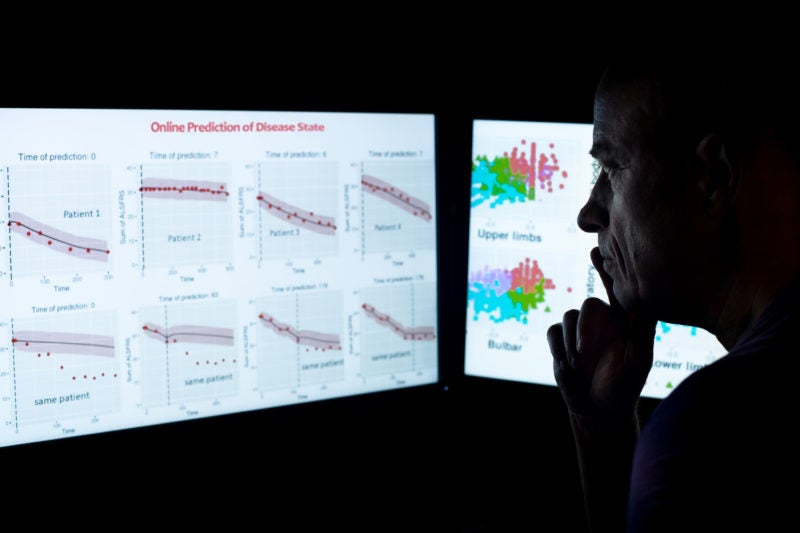
BGN Technologies, the technology transfer company of Israel-based Ben-Gurion University (BGU), has unveiled a new artificial intelligence (AI) platform to monitor and predict the progression of neurodegenerative diseases.
Developed by professor Boaz Lerner at the BGU’s Department of Industrial Engineering and Management, the platform is expected to enable the identification of markers for personalised patient care and improved drug development.
Go deeper with GlobalData


Discover B2B Marketing That Performs
Combine business intelligence and editorial excellence to reach engaged professionals across 36 leading media platforms.
Initially, the platform will be used to track amyotrophic lateral sclerosis (ALS), with plans to expand its application to other neurodegenerative conditions, including Parkinson’s and Alzheimer’s diseases.
Complicated research and drug development for ALS is attributed to the heterogeneity of the patient population that results in variability in onset symptoms, disease progression rate and pattern, and survival.
BGN Technologies said that the new platform will improve care and quality of life for ALS patients through reliable stratification to homogenous sub-groups, and personalised prediction of disease progression rate and pattern.
The platform will utilise machine learning and data mining algorithms to analyse demographic and clinical data in order to generate models for predicting the rate and pattern of ALS progression.
These models can also be used to identify factors required for the prediction and stratify homogenous sub-groups from the heterogeneous ALS population.
In addition, the platform is expected to improve clinical trials design and the clinical evaluation of treatment by identifying markers of different sub-populations for which treatment is beneficial, in turn enhancing success rates of studies.
Lerner said: “The novel platform, which uses machine learning algorithms, will enable not only accurate prediction of disease progression, a crucial ingredient for better clinical trials, but also identification of interrelationships between demographics and measurable factors from physical examinations and patient functionality that will advance clinical research of this devastating condition.”
BGN Technologies intends to use recent funds from the Israel Innovation Authority to develop a system that will enable implementation of the new technology on personal computers (PCs), the cloud and cellular applications.


